Articles & Insights
Industry insights, regulatory updates, and color science from our team.
After synthetic dye phase-outs, how should a formulator build a clean-label colorant decision tree?
The fastest defensible sequence is: target shade → matrix conditions → regulatory status → cost-in-use → supplier documentation. For water-based red/pink, first compare beetroot red (E 162) and anthocyanins (E 163); for orange/yellow, compare beta-carotene (E 160a) and curcumin (E 100); for tomato-r
How do you prevent carotenoid color and activity loss from light, heat, and oxygen in foods and supplements?
Carotenoids lose color mainly through light-catalyzed *trans*-to-*cis* isomerization and oxygen-driven oxidation; heat accelerates both pathways. The most practical defenses are selecting a stable delivery form — oil suspensions or beadlets rather than unprotected dry powders — and packaging in opaq
How do I specify a natural carotenoid for formulation: assay, carrier, form and stability?
Start with a closed specification that fixes the active assay as % total carotenoids and the active isomer or ester distribution, names the carrier and physical form, and sets a minimum assay after storage. Commonly available commercial grades include about 2.5% to 10% astaxanthin, 5% to 20% lutein
How does Yarrowia lipolytica fermentation change lycopene supply, assay and cost?
Yarrowia lipolytica fermentation shifts lycopene supply from tomato crop cycles and extraction byproducts to a controlled aerobic yeast fermentation that can run year-round, producing a supplier-specific lycopene form with a defined HPLC assay rather than a single commodity specification. Lycopene i
Fermentation lutein vs marigold lutein: which grade should you specify and why?
Fermentation-derived lutein and marigold-derived lutein are the same carotenoid molecule, but the grade you specify should follow from assay, ester form, carrier system, residual solvent profile, pesticide burden and regulatory route. In the EU both are permitted as E 161b under Regulation (EC) No 1
Astaxanthin yeast vs microalgae vs synthetic: how do I choose the right source for a food, feed or supplement formulation?
The source choice is primarily a regulatory decision, followed by cost per kg of active and the finished formulation format. For EU human food and supplements, the only astaxanthin source with a specific novel food authorisation is astaxanthin-rich oleoresin from *Haematococcus pluvialis*, listed un
Beet Root Powder Color Stability in Food: A Formulator's Practical Guide
Beetroot powder offers a clean-label red in moderate pH, low-water-activity and cold-process foods, but heat, light and oxygen limit its stability. Learn practical formulation strategies.
How EFSA Approves Natural Food Colors: The EU Pre-Market Process
A concise guide to how natural food colors are assessed and approved by EFSA under EU food additive law, with comparisons to US, Japan and Korea.
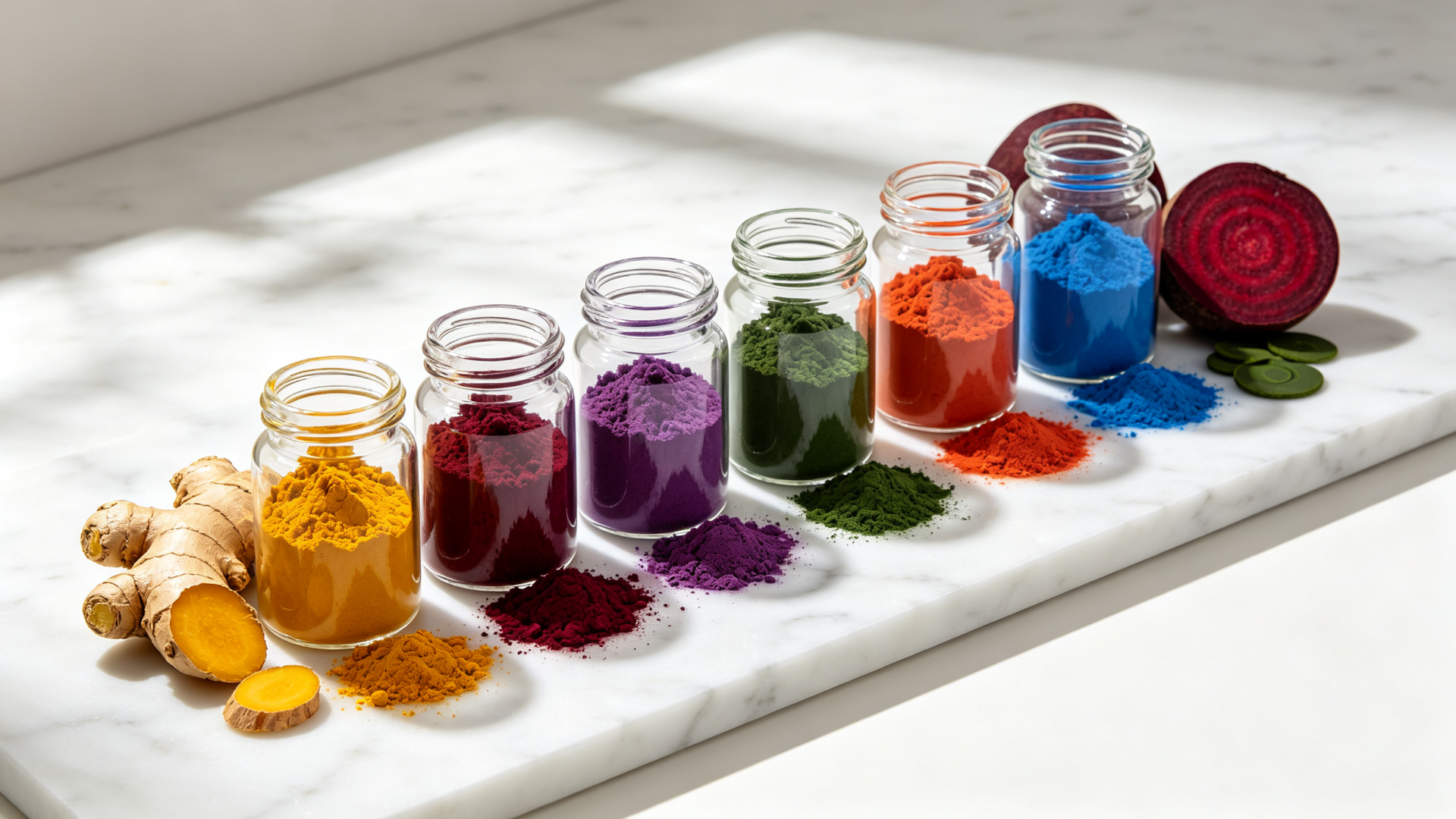
What to Use Instead of Synthetic Food Dyes: A 2027-Ready Guide to Natural Colorants
FDA is phasing out petroleum-based synthetic dyes, and Walmart's 2027 deadline is already reshaping reformulation pipelines. Here's what food and beverage formulators need to know about natural color alternatives—from curcumin to phycocyanin—and how to choose them.

What Is the Only Natural Blue Food Colorant?
The only commercially available, water-soluble, FDA GRAS natural blue food colorant is C-Phycocyanin, extracted from Spirulina. This guide explains why blue is rare, phycocyanin properties, applications, and how to choose a supplier.
Welcome to EarthHue
Our story, our standards, and what we ship.